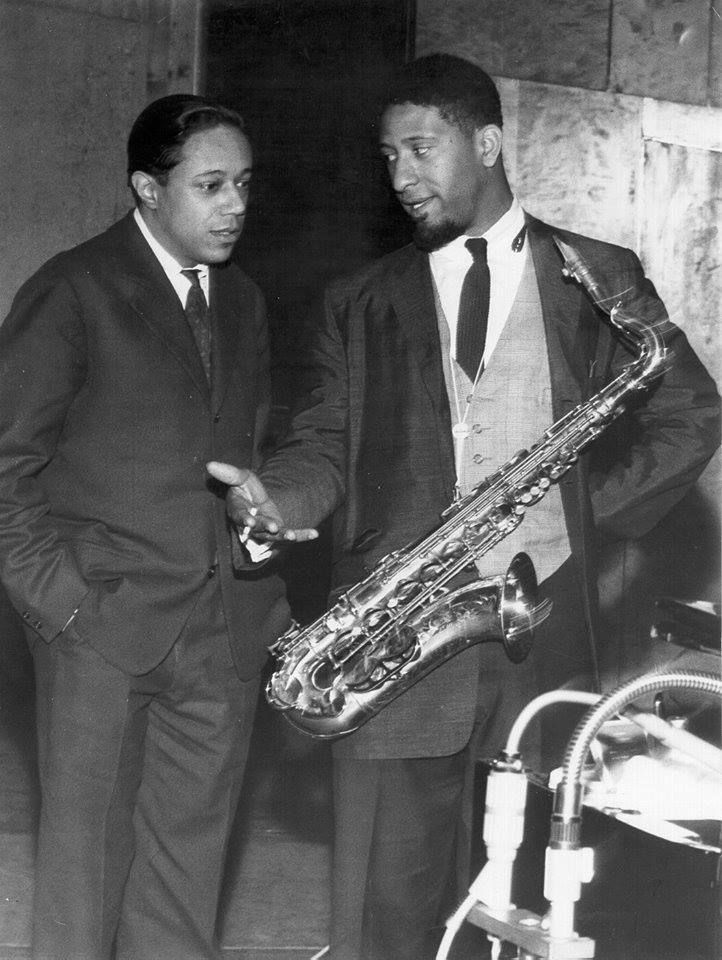
Having just celebrated his 94th birthday on September 7th, 2024, Sonny Rollins is a living legend. Sonny’s contributions as a composer are considerably important to the history of Black American Music. You can’t go to a jam session and not hear one of his many great tunes called.
His compositions, such as “Oleo”, “Doxy”, “St. Thomas” and “Airegin”, are essential stepping stones on the journey of any budding musician. As a composer, his influence on the repertoire is on par Charlie Parker, Miles Davis and Thelonious Monk. Though not quite as prolific as Monk or as sophisticated as Bird, his compositions’ longevity will be a lasting legacy. I can imagine they will be studied by future musicians for generations to come.
Sonny is well-known for taking a 3-year sabbatical spanning 1959–1962, where he sequestered himself to the Williamsburg Bridge and practiced his horn for hours a day. There is even an ongoing petition to rename the Williamsburg Bridge to “Sonny Rollins Bridge”.
This solo is from an earlier period of his career, when he was a member of Miles Davis’ “First Great Quintet”. First released in 1954 on a 10″ LP as Miles Davis with Sonny Rollins, this session was repackaged and released on 33 1/3 RPM LP as Bags’ Groove in 1957. It’s hard to believe this recording is over 70 years old!
Struggling with a heroin addiction, Sonny left Miles’ band in 1955 and was replaced by John Coltrane. This revised lineup of the “First Great Quintet” birthed the seminal Prestige recordings, including Workin’ With The Miles Davis Quintet. On this record, you can also find John Coltrane’s solo on Four, which I transcribed and posted earlier this year.
Learning The Solo
One characteristic of Sonny as an improviser is his ability to string melodic ideas through the duration of a solo. Listen to the ways he uses melodic sequences and repeated motifs throughout the solo. His solos are a great example of how to “tell a story” through improvisation. It is as though each motif is a character in that story, entering and exiting as the plot line develops.
The Transcription
You can view and download my PDF copy of the transcription. This is for educational purposes only, to give you a chance to compare the results of your own transcription practice.
You can really hear how he weaves together contrasting ideas throughout this two-chorus solo to tell a story. The first thing I noticed when listening to this solo is how Sonny uses space to create constrasting sonic textures. The solo begins with short phrases, punctuated by long rests. This builds tension and sets the stage for the dramatic flurry of notes we hear in the final 10 bars.
Now, let’s turn our attention to last “A” section of his first chorus (measures 25-27). The phrase he introduces in measure 13 makes a second appearance at measure 29. That phrase acts as a statement, the “call” in “call and response”, with the “response” in measures 14 and 30.
Note the variations between these response phrases. Measures 14 and 30 present the same harmonic idea (5-b3-9-1-7-6) using rhythm and octave displacements to create melodic variation.
Another motif in this solo can be found in the rhythmic figures starting on the “and” of beat two, in measures 2, 10, 34, 40 and 44.
My favorite “Easter egg” from this solo has to be how he restates the melodic idea introduced in measure 3, used to wrap up his solo in measures 63 and 64.
Finally, I want to point out two examples of how Sonny uses melodic sequences in his improvisational technique. The melodic cell heard in measure 38 is repeated in measure 39, adjusted to fit the harmony of the moment. In a similar manner, finale of the solo displays extensive use the four-note sequence “down-up-up” shape. We hear it 6 times in the final 12 bars of the solo, moving through the changes.
These are just a few examples of how Sonny is a master of thematic development in his solos. You can’t go wrong with Sonny Rollins. I’ve been digging deep into this album, as well as Sonny Rollins Plus 4, Newk’s Time, The Bridge, and of course, Saxophone Collosus.
Parting Wisdom
Now that I’ve finished transcribing this solo, I’ll be digging into my vaults and digitizing my transcription of Wardell Gray’s solo on “Bernie’s Tune” (Live at the Haig, 1953). I’m also starting on some Joe Henderson and Hank Mobley solos, that I hope to share with you by the end of the year.
As I finish them, new transcriptions will always be posted on my site. In the pursuit of quality, I will occasionally update and revise the solos when errors are discovered, or as I continue to hone my engraving skills.
Stay tuned for that, and even more great saxophone content.
Please Donate!
If you find my work to provide a benefit to your musical studies, please consider making a donation so I can keep making these solos available.
 Matt Mrozinski