
It’s a beautiful summer morning in June and I’m getting ready to publish my transcription of Stan Getz’s burning solo on Lover, Come Back To Me.
Lover, Come Back To Me is a standard tune composed by Sigmund Romberg with lyrics by Oscar Hammerstein II. It was first released in 1928 as featured in the Broadway musical The New Moon. This show also introduced the jam session favorite Softly, As In A Morning Sunrise to the world.
Singing The Solo, Learning The Tune
I began this transcription almost two years ago. Due to the crazy fast tempo and length of the form, just simply digesting the tune and navigating Getz’s long, twisting lines of his solo was a major challenge. Thankfully, I persisted and am finding myself much more comfortable with the tempo.
My process in the Beginner’s 5-Step Guide To Transcribing Solos was largely developed through this feat of transcription. I had a handful of solos under my belt that I worked out in writing, line-by-line, and my mission with this solo was to develop the entire transcription on the horn first (of course, after learning to sing the solo). Again, thanks to the grueling clip that the band was playing at, I had to work this up to tempo in small phrases and really focus in sharply on the details of the rhythm and articulation. At such a fast tempo, it’s so easy to get derailed.
Learning the tune and the changes, I relied on this fabulous recording by Errol Garner. He takes it at a much more manageable tempo, and plays the melody in a straight style. This allowed me to lift the head and gain a working knowledge of the changes.
This song features an extended, 64-bar progression with a modified AABA form, with each section comprising 16 bars. The first two A sections have the same changes for 12 bars and the 2nd A section leads to the bridge with a quick minor iiø7-V7 to the relative minor of the tune (in concert pitch, Ab major modulating to F minor). The final A section features an 8-bar coda ending, and then the form repeats for the next chorus.
With its relatively static harmony that frequently sits on the same chord for 2 bars and sparse melody, this tune is more commonly heard played “up”. Case in point, this solo clocks in around 290 bpm:
Man, what a cut. I grabbed a copy of this on CD from Discogs and there are some great tracks, including an iconic recording of the ballad Body And Soul. This CD lived in my car on repeat for the better part of last year, and I practiced singing the solo on Lover, Come Back To Me for hours.
Transcribing The Solo
Once I got my head around the tune and all this material, I learned the solo phrase-by-phrase, looping and repeating sections. I would tackle a few bars at a time and check in on each chorus at my lessons. I was determined to learn the entire solo on the horn before I wrote down a single note.
After I got the full solo, I started to hand-write the transcription. I finally felt comfortable with the material and tempo around December of 2023 after having embarked on this transcription the previous November.
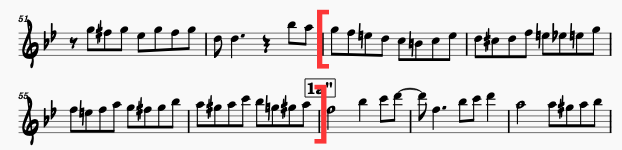
There were so many great repeating melodic patterns that I took some time to learn in all 12 keys, including the great licks at mm. 53-56 and mm. 81-84.
The first line below uses a half-step enclosure below each scale degrees in the C major scale before approaching the next note from the next scale degree above it. The changes here are relatively static, two bars of C7 and two bars of F7, but the line can also imply changes like: C7 | C7 | Cm7 | F7. Notice how the chromatic notes used in the line lets you access some cool colors via extensions and alterations from the F7 (the dominant back to Bb major, or I), like the b9 and #9, borrowing some notes from “outside” the key to add some color.
Similarly, this line at mm. 81-84 animates a more static progression in the tune, two bars of Bb6 followed by two bars of a Edim7. Each melodic cell outlines a descending diatonic arpeggio (starting in beat 3 of measure 81) and ends with a note a half step below the next downbeat, starting at the Tonic (I), walking up to the minor 3rd and back down to the minor 6th. So in this context, we see Bb6 | Bb6 | Edim7 | Edim7 | come to life as Bb6-Bb6 | Cm7-Dm7 | Cm7-Bb6 | Aø7 – Gm or [ I6 | ii7 – iii7 | ii7 – I6 | viiø7 – vi7]
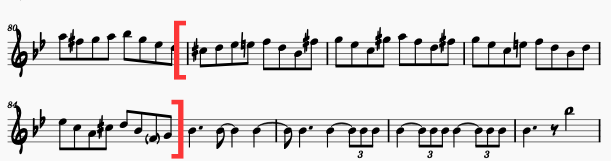
I know that one way I could improve as an improviser is by making longer phrases and ideas come out in my playing. With these two phrases, we hear a context for what are essentially scale and chord exercises. When I first started learning improvisation, I practiced very similar diatonic exercises; but finding the right context to use them and have them “fit” the changes in such an elegant way was a mystery.
The Transcription
You can view and download my PDF copy of the transcription. This is for educational purposes only, to give you a chance to compare the results of your own transcription practice.
Parting Wisdom
We’ll be working on more transcriptions and they will always be posted on my site when they’re finished and uploaded. In the pursuit of quality, I will occasionally update and revise the solos when errors are discovered, or as I continue to hone my engraving skills.
The next solo I’ll be posting is John Coltrane’s solo on Four from the Miles Davis Quintet Workin’ With The Miles Davis Quintet.
Stay tuned for that, and even more great saxophone content.
Please Donate!
If you find my work to provide a benefit to your musical studies, please consider making a donation so I can keep making these solos available.
 Matt Mrozinski